In landscaping, gardening, and construction projects, geotextile fabric and landscape fabric are often used interchangeably. But actually they have distinct differences in purposes, materials, and application scenarios.
First of all, we need to clarify the the differences based on the following definitions.
Geotextile mainly refers to non-woven geotextile fabric used in engineering and civil construction.
Landscape fabric mainly includes woven weed barrier fabric and heavy duty needle punched landscape fabric designed for weed control and landscaping applications.
Geotextile fabric is a permeable textile material widely used in civil engineering and landscaping applications to improve soil stability, drainage, and filtration.
It is primarily manufactured from polypropylene (PP) or polyester (PET). These two materials differ not only in performance but also in production processes. PP geotextiles are typically produced through lower-temperature extrusion and needle-punched non-woven processes, which make them cost-effective and widely used in general landscaping and construction projects. In contrast, polyester geotextiles require higher-temperature fiber production and are often manufactured into continuous filament structures, resulting in higher tensile strength and better long-term durability.
Geotextile fabrics can be produced in two main forms: woven and non-woven. Woven geotextiles are made by interlacing polypropylene yarns to achieve high strength and are commonly used for reinforcement purposes. Non-woven geotextiles are produced by mechanically bonding fibers together through needle-punching, offering excellent permeability and filtration performance.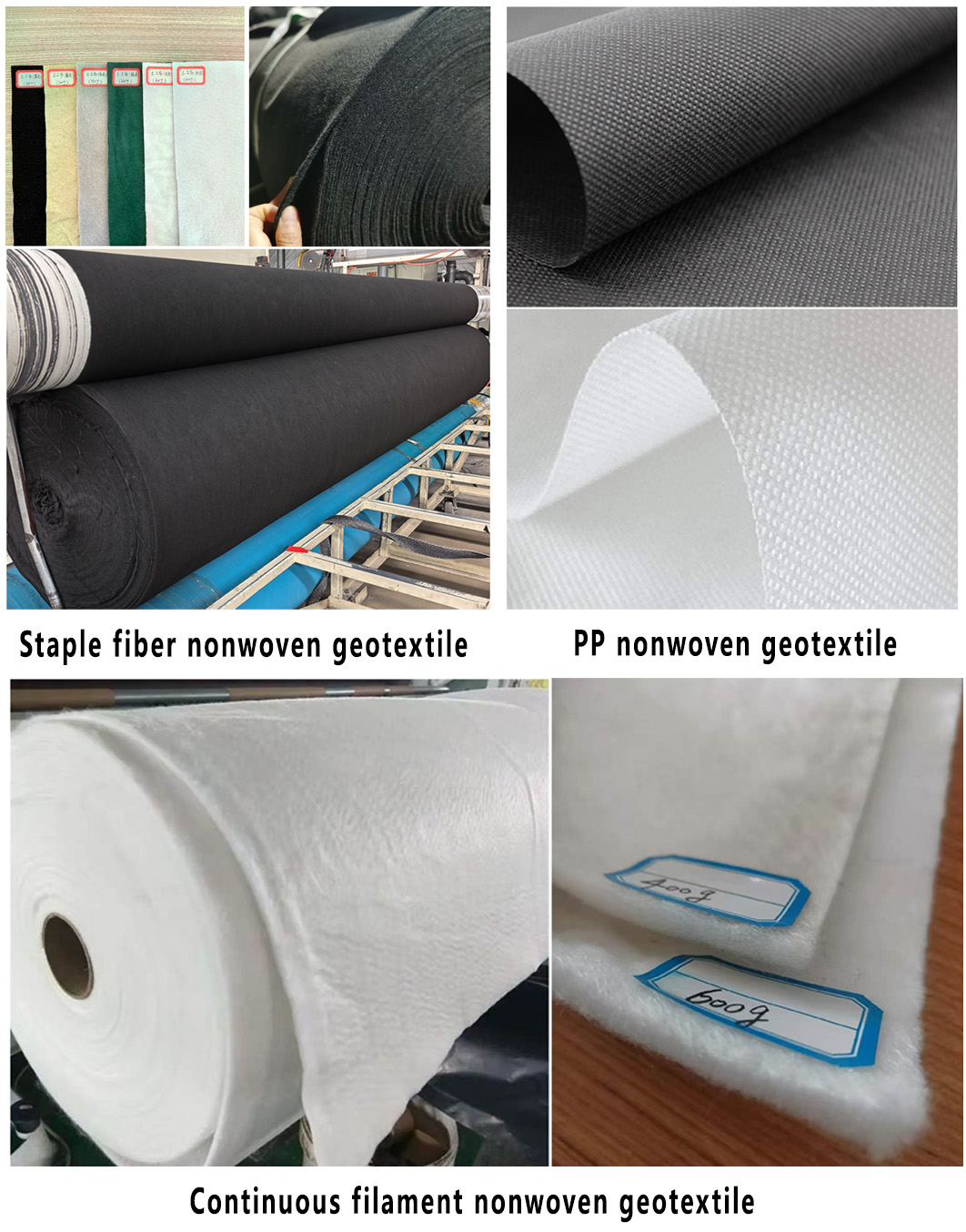
Soil separation between different layers
Drainage and water filtration
Erosion control on slopes and roads
Reinforcement of weak soil structures
Unlike lightweight landscape fabric used mainly for weed suppression in gardening, geotextile fabric is designed for engineering and structural applications such as roads, embankments, and drainage systems.
Landscape fabric, also known as weed barrier fabric, is a permeable material used in landscaping and gardening to suppress weed growth while allowing water, air, and nutrients to pass through the soil.
It is commonly made from polypropylene (PP) and is available in different structures, including woven and non-woven types. Based on strength and application requirements, landscape fabric can be classified into standard garden-grade fabrics and heavy-duty reinforced fabrics.
Standard landscape fabric is typically made from PP non-woven or woven structures and is used for basic weed control in flower beds, gardens, and landscape areas.
Heavy-duty landscape fabric needle-punched fabric is manufactured using a PP woven weed barrier fabric base combined with polyester (PET) fiber reinforcement. This composite structure improves tensile strength, puncture resistance, and durability while maintaining good permeability. It is widely used in areas that require stronger performance and longer service life.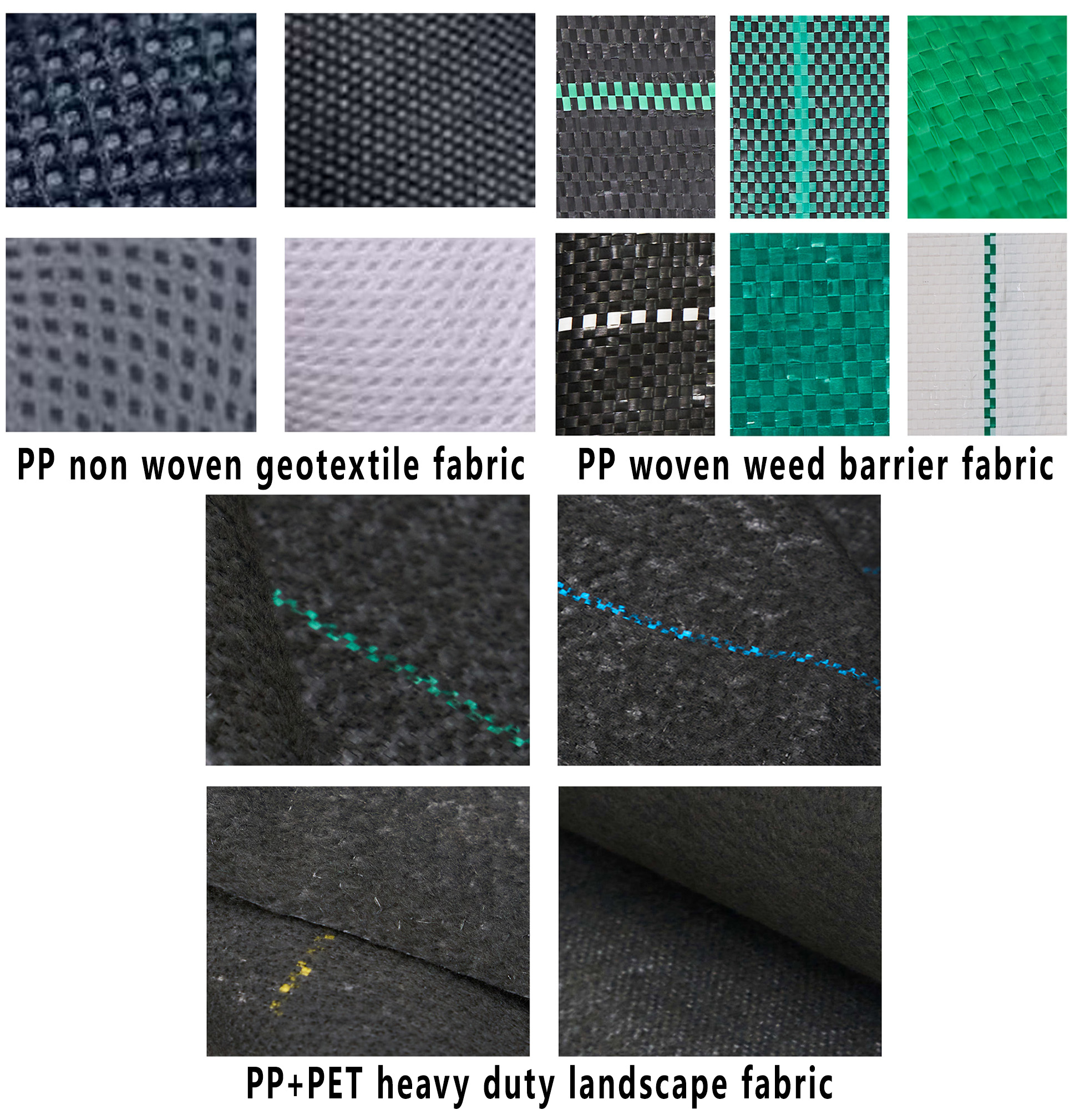
Garden weed control
Flower beds and vegetable gardens
Landscaping ground cover
Soil moisture and temperature regulation
Heavy-duty landscaping and commercial ground stabilization
Although different types of landscape fabric vary in structure and strength, their core purpose is to block sunlight, suppress weed growth, and improve soil management efficiency in both residential and commercial applications.

Although geotextile fabric and landscape fabric may appear similar, they are designed for different purposes and performance levels. Geotextile fabric is primarily an engineering material used in civil construction, while landscape fabric is mainly a gardening material designed for weed control and surface protection.
Geotextile fabric is engineered for structural and functional applications such as soil stabilization, drainage, filtration, and reinforcement. It is widely used in infrastructure projects including roads, embankments, and erosion control systems.
Landscape fabric, on the other hand, is designed for landscaping and gardening use. Its main purpose is to block sunlight and suppress weed growth while maintaining soil moisture and allowing air and water to pass through.
Geotextile fabrics are commonly made from polypropylene (PP) or polyester (PET), depending on strength and durability requirements. Heavy-duty versions may use composite structures such as a PP woven base combined with PET fiber reinforcement.
Landscape fabric is typically made from polypropylene (PP) and is available in woven or non-woven structures. Standard versions focus on weed control, while heavy-duty versions may use reinforced needle-punched composite construction.
Geotextile fabric generally offers higher tensile strength, puncture resistance, and long-term durability, especially in engineering-grade applications.
Landscape fabric is lighter in weight and designed for moderate durability, making it suitable for residential gardening and landscaping use rather than heavy load-bearing environments.
Geotextile fabric provides controlled permeability, allowing efficient drainage while preventing soil migration and mixing between layers.
Landscape fabric provides sufficient permeability for irrigation and plant growth but focuses more on blocking sunlight to control weeds rather than soil engineering performance.
Geotextile fabric is commonly used in:
Road construction and base stabilization
Drainage systems
Erosion control on slopes
Soil reinforcement and separation
Landscape fabric is commonly used in:
Garden weed control
Flower beds and vegetable gardens
Landscaping ground cover
Residential landscape maintenance
Geotextile fabric is an engineering-grade material designed for structural performance and soil management, while landscape fabric is a gardening material focused on weed control and surface-level soil protection.
No, geotextile fabric and landscape fabric are not the same, although they may look similar and are both used in soil-related applications.
Geotextile fabric is an engineering-grade material designed for civil construction purposes such as soil stabilization, drainage, filtration, and reinforcement. It is commonly used in roads, embankments, and infrastructure projects where high strength and long-term durability are required.
Landscape fabric, on the other hand, is a gardening and landscaping material primarily designed for weed suppression. It works by blocking sunlight from reaching weed seeds while still allowing water and air to pass through the soil, making it suitable for flower beds, vegetable gardens, and general landscape maintenance.
The main reason they are often confused is that both materials are permeable textiles used in soil environments and can be made from similar raw materials such as polypropylene (PP). However, their structure, strength, and application purposes are significantly different.
In general, geotextile fabric is used for structural and engineering performance, while landscape fabric is used for surface-level weed control and garden protection.
Geotextile fabric is a broad category of permeable textiles used in civil engineering and landscaping applications for soil stabilization, drainage, filtration, and reinforcement. It can be manufactured in both woven and non-woven forms depending on the required strength and function.
Non-woven fabric refers specifically to a type of geotextile produced by mechanically bonding fibers together through needle-punching or thermal bonding, rather than weaving. It is characterized by a felt-like structure with high permeability and filtration capability.
In other words, non-woven fabric is a subcategory of geotextile fabric, not a completely separate material. However, the term “non-woven fabric” is also widely used in gardening products such as landscape fabric, where the focus is mainly on weed control rather than engineering performance.
Geotextile non-woven fabrics are typically heavier, stronger, and used in construction and drainage projects, while non-woven landscape fabrics are lighter and designed for residential gardening applications.
Geotextile fabric is a broad category of permeable textiles used in civil engineering and landscaping applications for soil stabilization, drainage, filtration, and reinforcement. It can be manufactured in both woven and non-woven forms depending on the required strength and function.
Non-woven fabric refers specifically to a type of geotextile produced by mechanically bonding fibers together through needle-punching or thermal bonding, rather than weaving. It is characterized by a felt-like structure with high permeability and filtration capability.
In other words, non-woven fabric is a subcategory of geotextile fabric, not a completely separate material. However, the term “non-woven fabric” is also widely used in gardening products such as landscape fabric, where the focus is mainly on weed control rather than engineering performance.
Geotextile non-woven fabrics are typically heavier, stronger, and used in construction and drainage projects, while non-woven landscape fabrics are lighter and designed for residential gardening applications.
Choosing between geotextile fabric and landscape fabric depends on your specific application and performance requirements.
If your project involves civil engineering work such as road construction, drainage systems, soil stabilization, or erosion control, geotextile fabric is the better choice. It is designed to handle high loads, provide long-term durability, and maintain soil structure in demanding environments.
If your application is focused on gardening or landscaping, such as weed control in flower beds, vegetable gardens, or residential landscape maintenance, landscape fabric is more suitable. It provides effective weed suppression while still allowing water and air to pass through the soil.
For heavy-duty landscaping projects that require higher strength than standard garden fabric, reinforced landscape fabric (such as PP woven base with PET needle-punched reinforcement) can be used as a middle option between gardening fabric and engineering-grade geotextiles.
In summary, the choice depends on whether your priority is structural performance or surface-level weed control.
No, geotextile fabric is not the same as landscape fabric. Geotextile fabric is an engineering-grade material used for soil stabilization, drainage, and reinforcement, while landscape fabric is mainly used for gardening and weed control applications.
Landscape fabric is mainly used to suppress weed growth in gardens and landscaped areas. It is commonly applied in flower beds, vegetable gardens, and ground cover projects to block sunlight while allowing water and air to pass through the soil.
Geotextile fabric is used in civil engineering applications such as road construction, drainage systems, erosion control, and soil stabilization. It helps separate soil layers, improve load distribution, and enhance ground durability.
Landscape fabric is generally available in three types: PP woven landscape fabric, PP non-woven landscape fabric, and heavy-duty reinforced needle-punched landscape fabric with PP woven base and PET fiber reinforcement.
Woven geotextile is made by interlacing polypropylene yarns to provide high tensile strength and reinforcement. Non-woven geotextile is produced by needle-punching or thermal bonding fibers, offering better permeability and filtration performance.
It depends on the application. Geotextile fabric is better for engineering and construction projects requiring high strength and durability, while landscape fabric is more suitable for gardening and weed control in residential or light landscaping applications.


